How to photograph the Orion Nebula (M42)
The brightest nebula in the sky, a star-forming region in Orion’s sword.
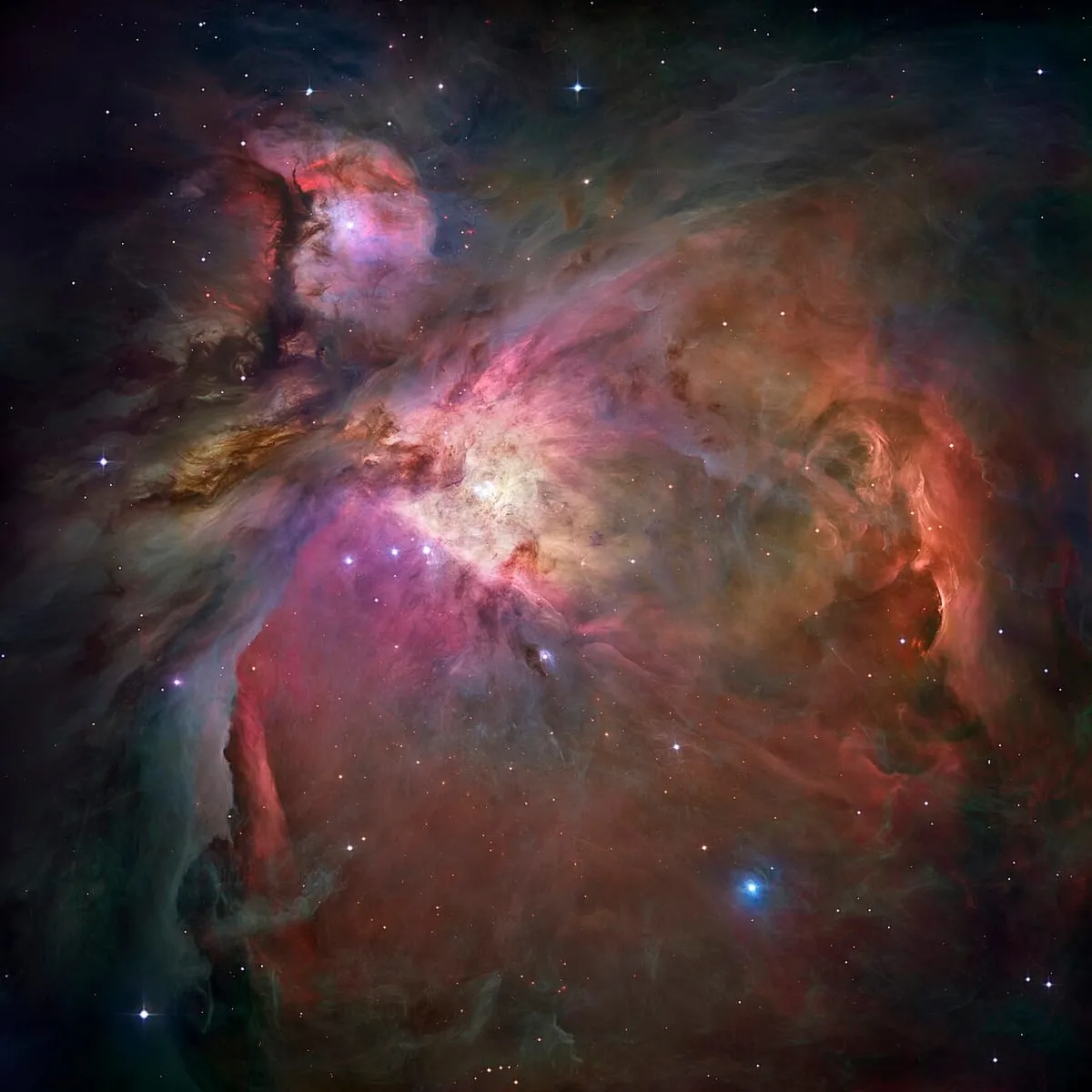
Photo byNASA, ESA, M. Robberto (Space Telescope Science Institute/ESA) and the Hubble Space Telescope Orion Treasury Project Team(Public domain)
When to shoot it from your location
About the Orion Nebula
M42 is bright enough to show up on a phone camera, and hours of exposure keep adding detail. Its glowing hydrogen makes it a good target under city light or moonlight with a dual-band filter. Unfiltered color frames also capture the blue reflection nebula M43 and the Running Man (NGC 1977) just to the north.
Gear and framing
The Orion Nebula spans about 85′ of sky. It frames best with:
- Telephoto (85-300mm lens)
- Small refractor (250-600mm)
- Long focal length (800mm and up)
You can see how other people have built their rigs on RigDesigner, including my Sony a6700 and 60mm refractor rig.
Filters
This target glows in emission lines and also has broadband detail. Unfiltered color frames under dark skies give the most natural colors. A dual-band filter lets you shoot it from the city or with the Moon up.
Tips
- The core (the Trapezium) saturates fast. Take a set of short exposures as well as long ones and blend them for a high dynamic range result.
- At 250-500mm it frames well with the Running Man Nebula.
- A dual-band filter makes it a good target even with the Moon up.
Processing
Stack your light frames with darks and flats, then remove the background gradient before stretching. AstroBake does all of this for you. Point it at your folders of raw frames, then adjust the result with live sliders.
Community shots of the Orion Nebula

Photographing the Orion Nebula with an Apertura 60mm refractor
The Orion Nebula with an Apertura 60mm doublet APO refractor on a Star Adventurer GTI mount.